
Radiators Part 3 – Small and thick or slim and big?

Time to continue the story about radiators for liquid cooling. We have covered the basics about radiators in the Part 1 blog, and in Part 2 we even showed some charts. Part 2 clarified things about radiator performance, how radiator performance is expressed and how do we read radiator performance charts. We have shown how two of the most popular radiator sizes (120 and 140mm), with different thickness variants, relate to one another performance-wise.


FF Adapter Fittings for Tube Bends

Even though soft tubing is considered to be the beginner’s option, we cannot claim it’s easier to use than hard tubing. Some bends are just impossible to pull off with soft tubing. We have talked about various types of tubing in our “Fittings and tubing guide” where we mentioned the kinking effect on soft tubing. Soft tubing kind of “has a mind of its own”. It tends to go its own way… and if you make a bend too tight, the tube will collapse and stop the flow of coolant.

What is CLC and how to use it?

Let us introduce you to the CLC! It stands for “Custom Loop Configurator” and by knowing that, you get the general idea what it’s good for. The CLC is a one of a kind, there is no other similar webpage/software available that will help you to build your basic custom liquid cooling system.

Radiators Part 2 – Performance

The fundamental rule of radiator performance testing is to see how well the radiator cools the coolant. For us, computer geeks, the most widespread way of describing radiator performance is by using W/10°C, or in other words, Watts per 10 Delta T (sometimes K is used instead of ΔT). To make it easier to understand, we are going to look at some performance charts.

Radiators Part 1 – Thickness and FPI

In the next few weeks, we are going to concentrate on radiators for a bit. There will be a series of blogs, all dedicated to radiators and the basics you need to know about them.

How to swap the mounting bracket? Easy!

AMD is heating things up their new Zen microarchitecture and we came prepared to the party! With the release of the new Ryzen™ CPUs and A-series APUs codenamed Bristol Ridge, the AMD water cooling community will bloom again and that is why we prepared a short tutorial.

Useful PWM cables

Tips and tricks about different PWM cables and how to use them in the liquid cooling loop to gain more silence and better performance control.

Which pump should you use? D5 or DDC?

Our support is usually bombarded with questions about the differences between D5 and DDC. In this article, we take a closer look at D5 and DDC pumps.

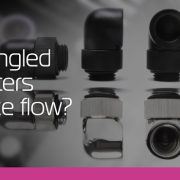
Do angled adapter fittings really reduce flow?

Probably one of the most quoted pieces of advice on building a liquid cooling loop is “don’t use many angled adapters, they reduce your flow rates”. So, is it true?

What to look for when buying a case for liquid cooling?

There is a TON of cases on the market! Dozens of brands with high-end and low-end models of cases are available. It’s hard to pick the right case if you are a demanding user, but especially if you are looking for a case that can fully support liquid cooling.